Pick Board Games

Interactive rulebook

CATAN Rules: Interactive Rulebook With Quick Answers

Every CATAN rule as a question you can search: setup, your turn, trading, building, the robber and how to win. Each answer links to the page of the official rulebook.

Official CATAN rulebook (PDF, English)12 pages

This page contains affiliate links. If you buy through them we earn a commission and you pay the same.

Players
3–4
Age
10+
At the table
60–120 min
  • CatanCatan3–4 players · 60–120 min

Overview

Overview & goal

Copy link

Collect resources, trade and build on Catan. First to 10 victory points on their own turn wins.

  1. Goal

    Reach 10 VPs on your turn.

    rulebook p. 2

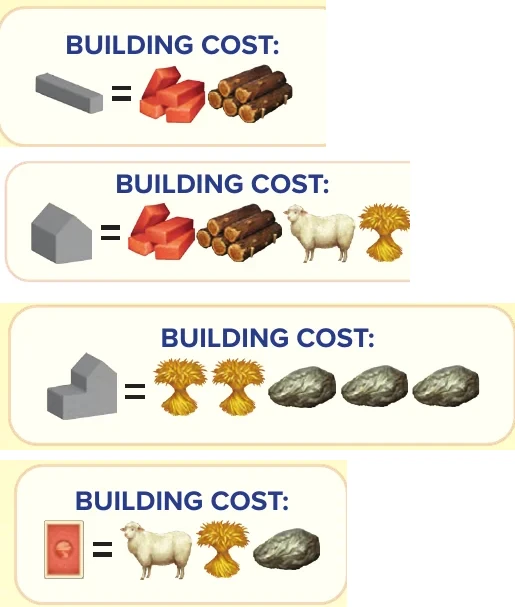
  2. Building costs: road, settlement, city, development card (CATAN rulebook p. 8–9)

    Build to score

    Settlements, cities and bonuses give points; resources pay for them.

    rulebook p. 8

What is the goal of CATAN?

Be the first player to reach 10 victory points on your own turn.

Full rule · p. 2

You win by being the first to reach 10 victory points (VPs) during your own turn. Points come from building settlements and cities and from bonuses: Longest Route, Largest Army and Victory Point cards. Resources from the board and from trading pay for everything you build.

rulebook p. 2Copy link

How many players can play?

3 or 4 with this box; with 3 players leave the white pieces out.

Full rule · p. 5

The base game has pieces in four colors. In a 3-player game the white pieces are not used.

rulebook p. 5Copy link

What resources are there and where do they come from?

Five: brick (hills), wood (forests), wool (pastures), wheat (fields) and ore (mountains). The desert gives nothing.

Full rule · p. 6

There are five resources with 19 cards each. Hills produce brick, forests wood, pastures wool, fields wheat and mountains ore. The desert produces nothing.

rulebook p. 6Copy link

Components

Components

Copy link

What's in the box.

What comes in the box?

Board pieces, 95 resource cards, 25 development cards, 2 bonus tiles, pieces in 4 colors, player aids, card trays, 2 dice and the robber.

Full rule · p. 3

Contents: 19 terrain hexes (4 forests, 4 pastures, 4 fields, 3 hills, 3 mountains, 1 desert), 6 sea frame pieces, 18 number discs, 95 resource cards (19 of each), 25 development cards, the Longest Route and Largest Army tiles, 4 player aids, 2 card trays, 2 dice, 1 robber, and per color 5 settlements, 4 cities and 15 roads.

rulebook p. 3Copy link

How many pieces does each player have?

5 settlements, 4 cities and 15 roads.

Full rule · p. 3

Each color has 5 settlements, 4 cities and 15 roads. A settlement comes back to you when you upgrade it to a city, so it can be built again; cities are capped at 4.

rulebook p. 3Copy link

Which development cards are in the deck?

25 cards: 14 Knight, 5 Victory Point, 2 Road Building, 2 Invention, 2 Monopoly.

Full rule · p. 3

The development deck has 25 cards: 14 Knight, 5 Victory Point, 2 Road Building, 2 Invention and 2 Monopoly.

rulebook p. 3Copy link

Setup

Setup (first game)

Copy link

Use the fixed beginner layout; starting pieces are pre-placed.

  1. 1. Frame

    Join the sea frame by matching numbers.

    2 questions →rulebook p. 4

  2. 2. Hexes & numbers

    Lay hexes and number discs as pictured.

    1 question →rulebook p. 4

  3. 3. Supply

    Resources in 5 face-up stacks, development deck face down, bonus tiles nearby.

    1 question →rulebook p. 4

  4. 4. Robber & pieces

    Robber on the desert; 2 settlements + 2 roads per player as shown (3 players: no white).

    1 question →rulebook p. 5

  5. 5. Starting resources

    1 card per hex next to your second settlement.

    3 questions →rulebook p. 5

  6. 6. First player

    Highest roll starts.

    1 question →rulebook p. 5

What is your question about?

How should I set up my first game?

Use the fixed setup on pages 4–5: board, numbers and starting pieces are all pre-placed.

Full rule · p. 4

For a first game the rulebook recommends the fixed setup: build the frame by matching numbers, place hexes and number discs as pictured, prepare the supply, put the robber on the desert and place each player's 2 starting settlements and roads where shown. Variable Setup (page 11) is for later games.

rulebook p. 4Copy link

How do I put the sea frame together?

Join the pieces so the numbers on their puzzle ends match.

Full rule · p. 4

In the fixed setup, connect the 6 sea frame pieces by matching the numbers on their puzzle-piece ends. In Variable Setup you shuffle them and connect them in any order.

rulebook p. 4Copy link

How do I set up the supply (bank)?

Five face-up resource stacks, the shuffled development deck face down, and the two bonus tiles beside the board.

Full rule · p. 4

Sort resource cards by type into five face-up stacks in the card trays, shuffle the development cards face down into the remaining slot, and place the Longest Route and Largest Army tiles near the board.

rulebook p. 4Copy link

Where does the robber start?

On the desert.

Full rule · p. 5

At setup the robber goes on the desert hex, in both the fixed and the variable setup.

rulebook p. 5Copy link

Which starting resources do I get?

One card for each hex next to your second settlement.

Full rule · p. 5

After placing starting pieces, each player takes one matching card per hex adjacent to their second settlement (outlined in black in the fixed setup). Keep them hidden.

rulebook p. 5Copy link

Do I get resources for my first settlement too?

No, only the hexes around your second settlement.

Full rule · p. 5

Starting resources come only from the hexes adjacent to the second settlement.

rulebook p. 5Copy link

Who goes first?

Everyone rolls; the highest roll starts.

Full rule · p. 5

Each player rolls both dice; the highest total is the first player. Play then goes clockwise.

rulebook p. 5Copy link

Are resource cards kept secret?

Yes, keep them hidden in your hand.

Full rule · p. 5

The rulebook tells players to keep resource cards hidden in hand.

rulebook p. 5Copy link

Your turn

Your turn: production

Copy link

Optional development card, roll, everyone collects; then the Action phase.

  1. Two phases

    Production, then Action. Then pass the dice left.

    4 questions →rulebook p. 6

  2. Optional card

    You may play 1 development card before rolling.

    1 question →rulebook p. 6

  3. Roll & collect

    Matching hexes produce: 1 card per settlement, 2 per city, for every player.

    4 questions →rulebook p. 6

  4. Terrain → resource

    Hills brick · Forests wood · Pastures wool · Fields wheat · Mountains ore · Desert nothing.

    2 questions →rulebook p. 6

What is your question about?

What happens on my turn?

Production (roll and collect), then Action (trade, build, play a card). Then pass the dice left.

Full rule · p. 6

Production phase: optionally play a development card, roll the dice, then collect resources or resolve a 7. Action phase: trade and build as you like and possibly play a development card. If you haven't won, pass the dice to your left.

rulebook p. 6Copy link

Which direction does play go?

Clockwise: the player on your left goes next.

Full rule · p. 6

Turns move clockwise from the first player.

rulebook p. 6Copy link

Can I trade or build before rolling?

No; before the roll you may only play a development card.

Full rule · p. 6

Production comes first. Trading and building belong to the Action phase, after resources are collected.

rulebook p. 6Copy link

Who gets resources when the dice are rolled?

Every player with a building on a hex showing that number, not just the roller.

Full rule · p. 6

All hexes whose number matches the roll produce. Each settlement on such a hex earns its owner 1 card; each city 2. This applies to every player.

rulebook p. 6Copy link

How much does a city produce?

2 cards instead of 1.

Full rule · p. 6

A city on a producing hex earns 2 cards of that resource; a settlement earns 1.

rulebook p. 6Copy link

If I have two settlements on the same hex, do I collect twice?

Yes, 1 card per settlement and 2 per city on that hex.

Full rule · p. 6

Each building is counted separately.

rulebook p. 6Copy link

What if the bank runs out of a resource?

If it can't pay everyone, nobody gets that resource; if only one player is owed, they take what's left.

Full rule · p. 6

When the supply can't cover all production of a resource, no one receives it. Exception: if only one player is affected, they get all remaining cards of it.

rulebook p. 6Copy link

Does the desert produce anything?

No, never.

Full rule · p. 6

The desert has no number and produces nothing.

rulebook p. 6Copy link

How many actions can I take in my Action phase?

As many as you can pay for, in any order (but only one development card per turn).

Full rule · p. 7

In the Action phase you trade and build as often as you like, in any order, while you have the resources.

rulebook p. 7Copy link

Can I build, then trade, then build again?

Yes, actions can be mixed in any order.

Full rule · p. 7

Trading and building can be alternated freely.

rulebook p. 7Copy link

Combat

Rolling a 7 & the robber

Copy link

On a 7: discard half if over 7 cards, move the robber, steal 1 card.

  1. No production

    A 7 produces nothing.

    3 questions →rulebook p. 6

  2. Discard

    Over 7 cards → discard half, rounded down.

    5 questions →rulebook p. 6

  3. Move & steal

    Move the robber to a new hex, steal 1 random card from a player there.

    6 questions →rulebook p. 6

What is your question about?

What happens when a 7 is rolled?

Nobody produces; players with more than 7 cards discard half, then the roller moves the robber and steals 1 random card.

Full rule · p. 6

On a 7 no hex produces. First, everyone holding more than 7 resource cards discards half, rounded down. Then the roller moves the robber to a new hex and steals 1 random resource card from a player with a building there.

rulebook p. 6Copy link

What happens if a 7 is rolled and I have 8 cards?

You discard 4, your choice.

Full rule · p. 6

Players with more than 7 resource cards discard half rounded down — 4 out of 8 — choosing which ones.

rulebook p. 6Copy link

Do I discard with exactly 7 cards?

No, only with more than 7.

Full rule · p. 6

Only hands of 8 or more resource cards discard.

rulebook p. 6Copy link

How many do I discard with 9 cards?

4: half, rounded down.

Full rule · p. 6

Half of 9 rounded down is 4 (the rulebook's own example).

rulebook p. 6Copy link

Does only the player who rolled the 7 discard?

No, every player with more than 7 cards discards.

Full rule · p. 6

The discard applies to each player over 7 resource cards.

rulebook p. 6Copy link

Can I leave the robber where it is?

No, it must move to a new hex.

Full rule · p. 6

Activating the robber always means moving it to a different hex.

rulebook p. 6Copy link

Can the robber go back to the desert?

Yes; the rulebook only requires a hex different from its current one.

Full rule · p. 6

The rule just says to move the robber to a new hex and does not exclude the desert.

rulebook p. 6Copy link

How does stealing work?

Take 1 random resource card, without looking, from a player with a building on the robber's new hex.

Full rule · p. 6

After moving the robber, steal one random resource card from a player with a settlement or city on that hex.

rulebook p. 6Copy link

If several players are on that hex, who do I rob?

You choose one of them.

Full rule · p. 6

With several players on the hex, the active player picks one to steal from; you steal only once.

rulebook p. 6Copy link

Does a hex with the robber produce?

No, not while the robber is on it.

Full rule · p. 6

A hex with the robber produces nothing when its number is rolled.

rulebook p. 6Copy link

Does anything produce on a 7?

No.

Full rule · p. 6

On a 7 there is no production; you resolve the discard and the robber instead.

rulebook p. 6Copy link

Can the robber steal development cards?

No, only resource cards.

Full rule · p. 9

Development cards are kept separate and hidden; the robber can't take them.

rulebook p. 9Copy link

Do development cards count toward the 7-card limit?

No, only resource cards count.

Full rule · p. 9

Development cards are ignored when checking for more than 7 cards.

rulebook p. 9Copy link

Can I move the robber without rolling a 7?

Yes, by playing a Knight.

Full rule · p. 9

A Knight makes you activate the robber: move it to a new hex and steal 1 random card. Discarding only happens on a rolled 7.

rulebook p. 9Copy link

Actions

Trade (market)

Copy link

Trade with players, with the bank 4:1, or at ports 3:1 / 2:1 — only on your turn.

  1. With players

    Propose a deal; others accept or counter. No gifts.

    4 questions →rulebook p. 7

  2. Bank 4:1

    4 identical cards → 1 of your choice.

    3 questions →rulebook p. 7

  3. Ports 3:1 / 2:1

    Need a settlement or city on the port.

    5 questions →rulebook p. 7

What is your question about?

How does trading (the market) work?

On your turn you trade with other players, with the bank at 4:1, or at 3:1 / 2:1 if you have a port.

Full rule · p. 7

During your Action phase there are three kinds of trade: with other players (any deal they accept, but no gifts), with the supply at 4 identical cards for 1, and at a port (3:1 or 2:1) where you have a settlement or city. Only the active player trades.

rulebook p. 7Copy link

Can I trade with the bank on another player's turn?

No; on someone else's turn you may only trade with that player.

Full rule · p. 7

During another player's turn you can trade only with them — not with other players and not with the supply.

rulebook p. 7Copy link

Can two players trade with each other when it isn't their turn?

No, every trade must involve the active player.

Full rule · p. 7

Non-active players may only trade with the player whose turn it is.

rulebook p. 7Copy link

How do I propose a trade?

Say what you want and what you'll give; others accept, counter-offer or propose their own deal.

Full rule · p. 7

Announce the resources you want and those you'll give. Other players may accept, counter-offer or make their own proposals.

rulebook p. 7Copy link

Can I give cards to another player for free?

No, giving cards away is not allowed in any form.

Full rule · p. 7

Gifts are forbidden, including disguised ones such as swapping several cards of a resource for one of the same.

rulebook p. 7Copy link

Can I trade 3 ore for 1 ore?

No, trading matching resources counts as giving cards away.

Full rule · p. 7

Swapping cards of the same type is effectively a gift and is not allowed.

rulebook p. 7Copy link

How does trading with the bank work?

Give 4 cards of the same resource and take 1 of a different resource.

Full rule · p. 7

General trade with the supply: return 4 identical resource cards and take 1 card of another resource. No port needed.

rulebook p. 7Copy link

Can I give the bank 4 different cards for 1?

No, the 4 cards must be the same resource.

Full rule · p. 7

The 4:1 trade requires 4 cards of one type.

rulebook p. 7Copy link

How does a 3:1 port work?

With a building on it, trade 3 identical cards for 1 of a different resource.

Full rule · p. 7

With a settlement or city on a 3:1 port, return 3 cards of one resource and take 1 of another.

rulebook p. 7Copy link

How does a 2:1 port work?

With a building on it, trade 2 of the resource shown on the port for 1 of a different resource.

Full rule · p. 7

A 2:1 port only works with its pictured resource: return 2 of it and take 1 of another.

rulebook p. 7Copy link

Can I use a 2:1 wheat port to trade wood?

No, a 2:1 port only takes its own resource.

Full rule · p. 7

For other resources use a 3:1 port or the 4:1 bank trade.

rulebook p. 7Copy link

What do I need to use a port?

A settlement or city on that port; a road alone isn't enough.

Full rule · p. 7

Port trades require one of your buildings on the port.

rulebook p. 7Copy link

Can I use my port on another player's turn?

No, trading with the supply, ports included, only happens on your turn.

Full rule · p. 7

Off-turn you can only trade with the active player.

rulebook p. 7Copy link

Is there a limit to how many trades I can make?

No, trade as often as you like in your Action phase.

Full rule · p. 7

Actions, including trades, can be repeated while you have cards.

rulebook p. 7Copy link

Can I trade development cards?

No, they can't be traded or given away.

Full rule · p. 9

Only resource cards can be traded.

rulebook p. 9Copy link

Actions

Pay resources to place roads, settlements and cities.

  1. Costs

    Road brick+wood · Settlement brick+wood+wool+wheat · City 2 wheat+3 ore · Dev card wool+wheat+ore.

    2 questions →rulebook p. 8

  2. Roads

    Connect to your network; not past an opponent's building.

    6 questions →rulebook p. 8

  3. Settlements

    On your road, two edges from any building.

    5 questions →rulebook p. 8

  4. Cities

    Replace a settlement; max 4.

    3 questions →rulebook p. 9

  5. Longest Route

    5+ continuous roads = 2 VPs.

    4 questions →rulebook p. 8

What is your question about?

What does each thing cost?

Road: brick + wood. Settlement: brick + wood + wool + wheat. City: 2 wheat + 3 ore. Development card: wool + wheat + ore.

Full rule · p. 8

To build, return the cost to the supply. Road = 1 brick + 1 wood (0 VP). Settlement = 1 brick + 1 wood + 1 wool + 1 wheat (1 VP). City = 2 wheat + 3 ore (2 VPs). Development card = 1 wool + 1 wheat + 1 ore.

rulebook p. 8Copy link

Can I build several roads in one turn?

Yes, as many as you can pay for and have pieces for.

Full rule · p. 8

There's no per-turn limit: each road costs 1 brick + 1 wood, and you can repeat while you have resources and road pieces (15 per color).

rulebook p. 8Copy link

Is there a limit on how much I build per turn?

No, only your resources and remaining pieces limit you.

Full rule · p. 8

You may build as often as you like in the Action phase.

rulebook p. 8Copy link

Do roads have to connect to my own?

Yes, to one of your roads, settlements or cities.

Full rule · p. 8

Roads go on empty edges and must touch one of your existing roads or buildings.

rulebook p. 8Copy link

Can my road continue past an opponent's settlement?

No, you can't build a road starting on the other side of an opponent's building.

Full rule · p. 8

An opponent's settlement or city cuts the connection at that intersection.

rulebook p. 8Copy link

Can I put a road on an edge that already has one?

No, roads go only on empty edges.

Full rule · p. 8

Each edge holds one road.

rulebook p. 8Copy link

Are roads worth points?

No, 0 VP — but 5+ continuous roads can earn Longest Route (2 VPs).

Full rule · p. 8

Roads give no points themselves; they let you expand and can win Longest Route.

rulebook p. 8Copy link

Where can I build a settlement?

On an empty intersection connected to your road, following the distance rule.

Full rule · p. 8

A new settlement goes on an empty intersection, must touch at least one of your roads, and must be at least two edges from every other building.

rulebook p. 8Copy link

Can I build a settlement that isn't connected to my roads?

No, after setup every settlement must connect to one of your roads.

Full rule · p. 8

Only starting settlements are placed freely.

rulebook p. 8Copy link

What is the distance rule?

A settlement must be at least two edges from every other building: no buildings on neighbouring intersections.

Full rule · p. 8

When placing a settlement, the adjacent intersections must have no buildings, yours or anyone else's.

rulebook p. 8Copy link

Does the distance rule apply to my own buildings too?

Yes, to all buildings.

Full rule · p. 8

The rule covers all other buildings, including yours.

rulebook p. 8Copy link

What if I've used all 5 settlements?

Upgrade one to a city; that settlement comes back and can be rebuilt.

Full rule · p. 8

With only 5 settlement pieces, you must first upgrade one to a city to build more.

rulebook p. 8Copy link

Can I build a city on an empty spot?

No, a city always replaces one of your settlements.

Full rule · p. 9

Remove one of your settlements and put the city in its place.

rulebook p. 9Copy link

How many cities can I have?

4 at most.

Full rule · p. 9

Each player has 4 cities and can't build more.

rulebook p. 9Copy link

How many points is a city worth?

2 VPs (a settlement is 1).

Full rule · p. 9

A city is worth 2 VPs and produces 2 cards instead of 1.

rulebook p. 9Copy link

What if I run out of road pieces?

You can't build more roads; each player has 15.

Full rule · p. 8

Pieces are limited: 15 roads, 5 settlements, 4 cities per color.

rulebook p. 8Copy link

How do I get Longest Route (longest road)?

Be the first with 5 continuous roads; worth 2 VPs, and it passes to anyone with a longer route.

Full rule · p. 8

The first player with a continuous route of 5+ roads takes the tile (2 VPs). If another player gets more continuous roads, they take it immediately.

rulebook p. 8Copy link

If someone ties my longest road, do they take the tile?

No, they need more continuous roads, not the same number.

Full rule · p. 8

The tile changes hands only when someone has more.

rulebook p. 8Copy link

Can an opponent break my longest road?

Yes, by building a settlement on an intersection of your route.

Full rule · p. 8

An opponent's settlement in your route splits it into separate segments, which may cost you the tile.

rulebook p. 8Copy link

What happens to Longest Route if my road is broken?

If you no longer qualify, it returns to the supply until one player alone has the longest route of 5+.

Full rule · p. 8

The tile stays in the supply until a single player holds the longest continuous route of at least 5; that player takes it and its 2 VPs immediately.

rulebook p. 8Copy link

Actions

Development cards

Copy link

Buy for wool+wheat+ore; play 1 per turn, not the turn bought.

  1. Buy

    Draw the top card, keep it hidden.

    3 questions →rulebook p. 9

  2. Play

    1 per turn, before rolling or in the Action phase.

    10 questions →rulebook p. 9

  3. Largest Army

    3+ Knights played = 2 VPs.

    2 questions →rulebook p. 9

What is your question about?

How do I get a development card?

Pay wool + wheat + ore and draw the top card; keep it hidden.

Full rule · p. 9

A development card costs 1 wool, 1 wheat and 1 ore. Draw the top of the deck and keep it hidden until you play it.

rulebook p. 9Copy link

Can I play a development card the turn I buy it?

No — except Victory Point cards, which you may reveal right away if they make you win.

Full rule · p. 9

The card you play can't be one bought this turn. Exception: any number of VP cards, even bought this turn, can be revealed to win.

rulebook p. 9Copy link

How many development cards can I play per turn?

One (VP cards excepted when winning).

Full rule · p. 9

Only 1 development card per turn, placed face up in your area.

rulebook p. 9Copy link

When can I play a development card?

Before rolling or at any time in your Action phase.

Full rule · p. 9

Your one card per turn can be played before the roll or at any point in the Action phase.

rulebook p. 9Copy link

What if the development deck runs out?

No more can be bought; played cards never go back.

Full rule · p. 9

Development cards never return to the supply, so once the deck is empty nobody can buy more.

rulebook p. 9Copy link

What does the Knight card do?

You move the robber to a new hex and steal 1 random card.

Full rule · p. 9

Playing a Knight means you must Activate the Robber. Played Knights stay face up and count toward Largest Army.

rulebook p. 9Copy link

Can I play a Knight before rolling to move the robber off my hex?

Yes, development cards can be played before the roll.

Full rule · p. 9

Since a card can be played before rolling, a Knight can move the robber before production.

rulebook p. 9Copy link

What does Monopoly do?

Name one resource: every player gives you all their cards of that type.

Full rule · p. 9

Announce a single resource type; each player hands over all their cards of it.

rulebook p. 9Copy link

Can I name two resources with Monopoly?

No, only one, however many cards that gets you.

Full rule · p. 9

You may name exactly one resource, regardless of how many cards you receive.

rulebook p. 9Copy link

What does Invention do?

Take any 2 resource cards from the bank, same or different.

Full rule · p. 9

Take 2 resource cards of your choice from the supply; they may be two of the same or two different.

rulebook p. 9Copy link

What does Road Building do?

Build 2 roads for free.

Full rule · p. 9

Place 2 roads without spending any resources.

rulebook p. 9Copy link

When do I reveal Victory Point cards?

Only when they let you reach 10 VPs; otherwise keep them hidden.

Full rule · p. 9

Each VP card is worth 1 VP. Keep them hidden in your area and reveal all of them, including any bought this turn, when they give you enough to win.

rulebook p. 9Copy link

How do I get Largest Army?

Be the first with 3 Knights played; worth 2 VPs, and it passes to anyone with more Knights.

Full rule · p. 9

The first player with 3 Knights in play takes the tile (2 VPs). If another player has more Knights in play, they take it immediately.

rulebook p. 9Copy link

If someone ties my number of Knights, do they take Largest Army?

No, they need more Knights in play.

Full rule · p. 9

The tile only moves to a player with more Knights.

rulebook p. 9Copy link

Can I give a development card to another player?

No, they can't be traded or given away.

Full rule · p. 9

Development cards stay with whoever bought them.

rulebook p. 9Copy link

Scoring

Scoring

Copy link

Settlement 1, city 2, bonuses 2, VP card 1.

How are points counted?

Settlement 1, city 2, Longest Route 2, Largest Army 2, each VP card 1; roads 0.

Full rule · p. 10

Victory points: settlement 1, city 2, Longest Route tile 2, Largest Army tile 2, Victory Point card 1. Roads score nothing.

rulebook p. 10Copy link

What does a winning score look like?

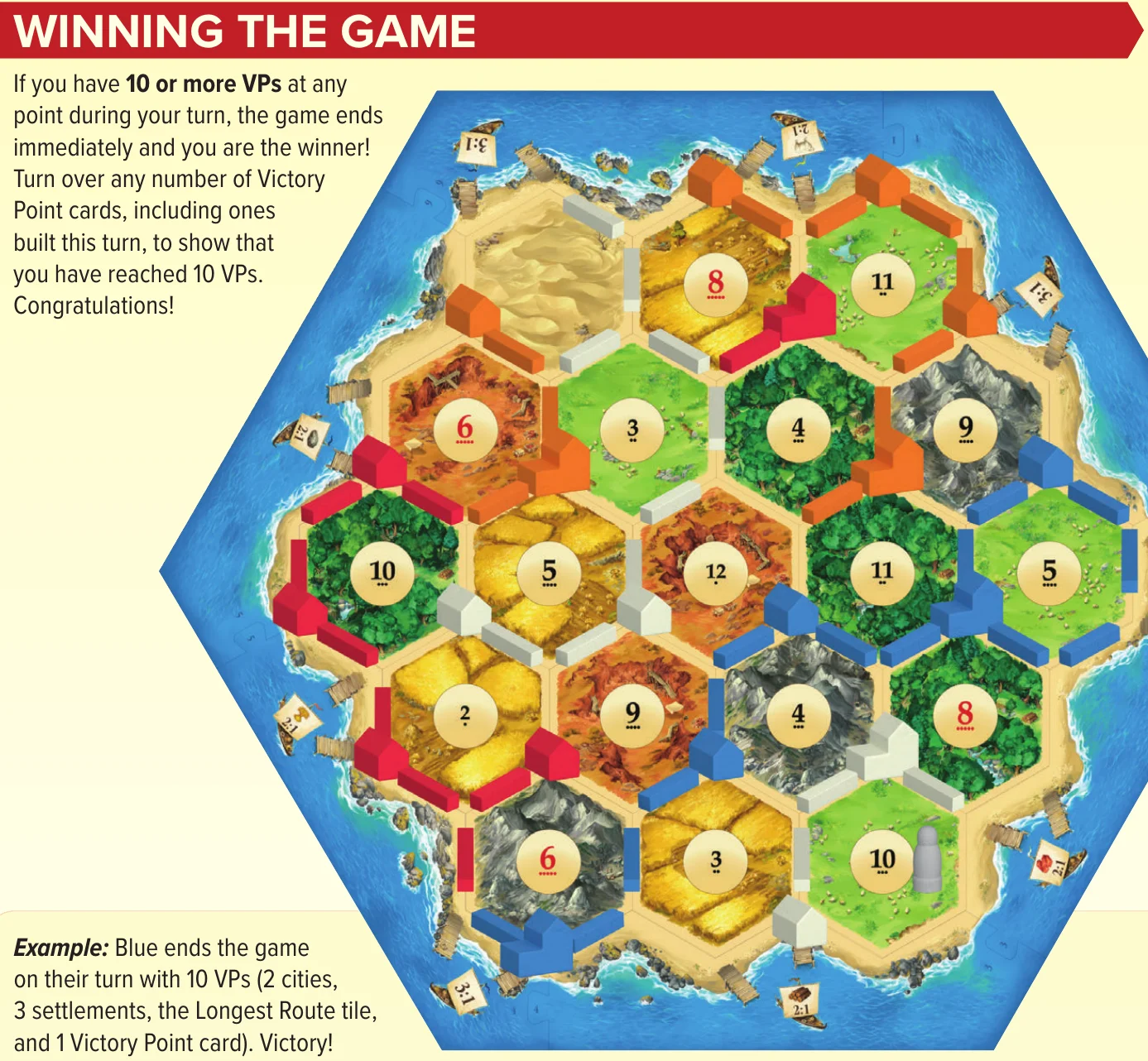
Rulebook example: 2 cities + 3 settlements + Longest Route + 1 VP card = 10.

Full rule · p. 10

2 cities (4) + 3 settlements (3) + Longest Route (2) + 1 Victory Point card (1) = 10 VPs.

rulebook p. 10Copy link

End of the game

Winning

Copy link

10 VPs on your turn ends the game immediately.

  1. End-of-game board example (CATAN rulebook p. 10)

    Reach 10

    Hit 10+ VPs on your turn and reveal VP cards.

    rulebook p. 10

When does the game end?

As soon as a player has 10 or more VPs during their own turn.

Full rule · p. 10

The game ends immediately when you have 10+ VPs at any point in your turn; reveal VP cards to prove it.

rulebook p. 10Copy link

Can I win on someone else's turn?

No, the win is checked during your own turn.

Full rule · p. 10

The rulebook ends the game when you have 10+ VPs during your turn.

rulebook p. 10Copy link

Does the round finish after someone reaches 10?

No, the game ends immediately.

Full rule · p. 10

There is no final round: the game ends the moment a player has 10 VPs on their turn.

rulebook p. 10Copy link

Do I need exactly 10 points?

No, 10 or more.

Full rule · p. 10

Reaching 10 or more VPs on your turn wins.

rulebook p. 10Copy link

Variants

Variable setup

Copy link

Random board and players place their own starting pieces.

  1. Random board

    Random frame and hexes; numbers A-B-C counterclockwise, skipping the desert.

    rulebook p. 11

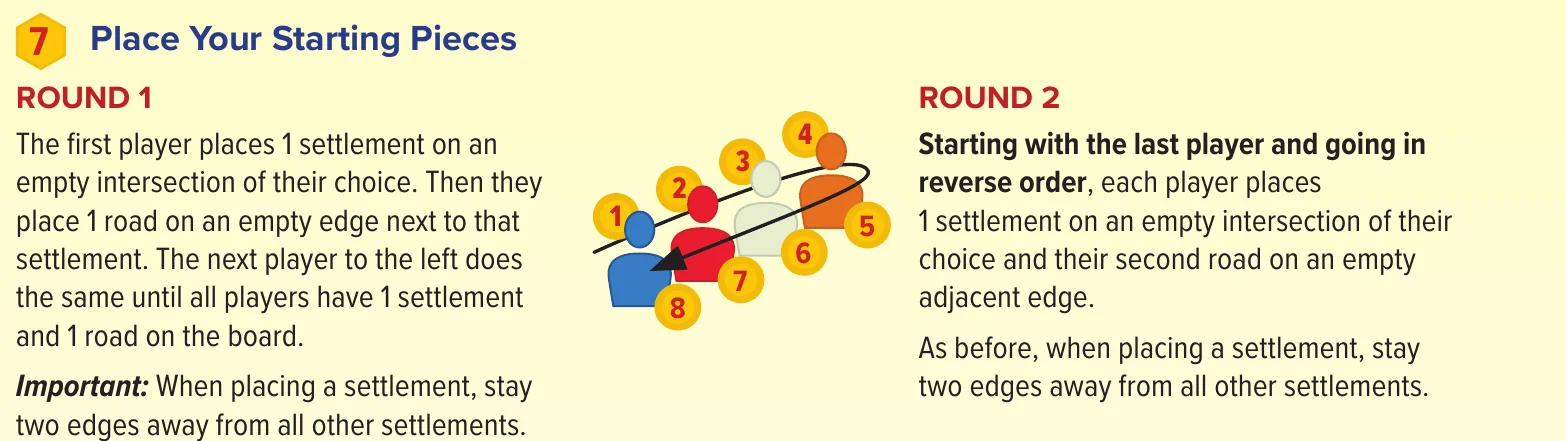
  2. Starting placement order: round 1 then round 2 in reverse (CATAN rulebook p. 12)

    Place pieces

    Round 1 clockwise, round 2 in reverse; resources from the second settlement.

    rulebook p. 12

How does the variable (random) setup work?

Random frame and hexes, number discs in A-B-C order counterclockwise, then players place their own starting pieces.

Full rule · p. 11

Shuffle and connect the frame, place hexes randomly face up, lay number discs face down in A-B-C order from any corner going counterclockwise (skipping the desert) and flip them. Robber on the desert, prepare the supply, roll for first player, choose colors, place starting pieces in two rounds and take starting resources.

rulebook p. 11Copy link

Does the desert get a number disc?

No, skip the desert when placing number discs.

Full rule · p. 11

When laying discs in A-B-C order, the desert hex is skipped.

rulebook p. 11Copy link

In what order are starting settlements placed?

Round 1 clockwise from the first player; round 2 in reverse, starting with the last player.

Full rule · p. 12

Round 1: the first player places 1 settlement and an adjacent road, then the player to the left, until everyone has one of each. Round 2: starting with the last player and going in reverse, each places a second settlement and road. The last player therefore places twice in a row.

rulebook p. 12Copy link

Does the distance rule apply to starting settlements?

Yes, they must also be two edges away from all other settlements.

Full rule · p. 12

In both placement rounds each settlement must stay at least two edges from every other settlement.

rulebook p. 12Copy link

Where does my starting road go?

On an empty edge next to the settlement you just placed.

Full rule · p. 12

Each starting road goes on an empty edge adjacent to the settlement placed that round.

rulebook p. 12Copy link

Updated 16 October 2026 · from our own catalogue