Which game is easier to teach to non-gamers?
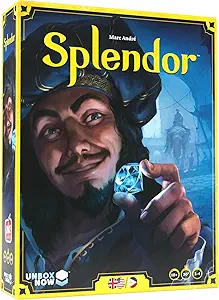
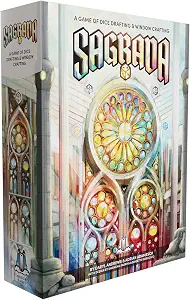
Splendor is noticeably easier to teach. A turn consists of only three possible actions: take chips, reserve a card, or buy a card. Sagrada requires explaining dice placement adjacency, color and shade restrictions, tool card costs, and scoring objectives.
Can you play Sagrada or Splendor with two players?
Both work exceptionally well at two players. Splendor scales down its token pool to keep the drafting competitive, while Sagrada uses four dice per round across ten rounds, providing a tight, head-to-head draft.
Which game has less luck involved?
Splendor is more deterministic. While new cards arrive from the deck, all available purchases and costs remain visible on the table. Sagrada rolls random dice every round, though favor tokens and tool cards allow you to adjust values or swap placements.
Do you need expansions for either game?
No. Both base boxes provide dozens of hours of replay value. Sagrada's variable window difficulty cards and changing public objectives offer high variability out of the box, while Splendor's tight race remains compelling on its own.
Can you play either game on your own?
Sagrada includes a dedicated solo mode in the base box where you draft dice to beat a target score set by the round tracker. Splendor requires at least two players and does not include an official solo variant.
Can younger kids play Sagrada despite the 14+ age rating on the box?
Yes. Sagrada carries a 14+ label primarily due to formal component safety testing for small dice, but its actual puzzle complexity is comfortable for kids around 10. Splendor is slightly easier for younger children because card discounts require less spatial foresight than Sagrada's color and shade placement rules.
How different are Sagrada and Splendor to learn and play?
Both Sagrada and Splendor solve the holy grail of family gaming: rules that an eight- or ten-year-old can understand on their very first turn, paired with enough tactical nuance that four adults will spend an evening completely absorbed. Where they diverge entirely is the type of mental itch they scratch. Splendor is an economic sprint. You hoard gem chips to purchase development cards, and each card acts as a permanent discount toward pricier gems. Your turns snowball from scraping together single chips to claiming high-tier cards and noble visits in rapid succession. Sagrada, by contrast, is a spatial logic puzzle. You roll a shared pool of dice and snake-draft them onto personal 4×5 window frames. Placing a die requires obeying strict orthogonal rules: no matching colors or numbers may touch, while matching the specific shade or hue of individual spaces. Where Splendor rewards mathematical efficiency, Sagrada rewards spatial foresight and calculated risk management.
How much player interaction is there in Sagrada vs Splendor?
Neither game features hostile direct attacks or destroyed progress, making both safe picks for family game nights with sensitive players. However, both can become 'conversation killers' once players get comfortable with the strategy. In Splendor, turns are so quick that players spend their downtime calculating purchase paths and keeping an eye on whether someone is about to reserve the card they need. In Sagrada, drafting is open, so hate-drafting a die an opponent desperately needs is common, and the final three rounds often bring quiet concentration as board spaces fill up. If you frequently play at two, both scale gracefully. Splendor tightens its token pool and available nobles for two players, while Sagrada maintains its exact draft ratio. Furthermore, Sagrada includes an official solo puzzle in the box, giving it an extra dimension when nobody else is around to play.